PDF Download The Condemnation of Blackness: Race, Crime, and the Making of Modern Urban America, by Khalil Gibran Muhammad
Checking out is the very best thing to do to meet the time. Yeah, reviewing will certainly constantly bring goodness. Moreover, when you could recognize just what guide to read, it's truly well prepared. When you could check out the book ended up, you can get finished information that the writer utters. In this situation, this book always offers good things. The Condemnation Of Blackness: Race, Crime, And The Making Of Modern Urban America, By Khalil Gibran Muhammad naturally will be so crucial to accompany you in your spare time. Also it is only few web pages; you could read it by the times without forgetting just what you have actually read.
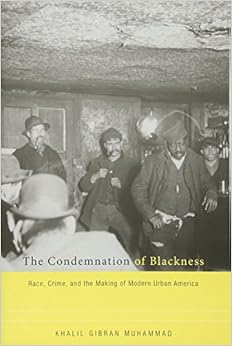
The Condemnation of Blackness: Race, Crime, and the Making of Modern Urban America, by Khalil Gibran Muhammad

PDF Download The Condemnation of Blackness: Race, Crime, and the Making of Modern Urban America, by Khalil Gibran Muhammad
Ways to win the challenges that constantly force you to work barely? Get the ideas, even more experiences, even more practices, and a lot more understanding. As well as where is the location to get it? Certainly, several areas are good colleges and also several points ready educator for you. And publication, as the home window to obtain open up the globe becomes one of the selection that you should get. What type of book? Obviously the book that will certainly support related to your necessity.
Reviewing is actually a should as well as this is very important in this life. When somebody reads whole lots, just make deal with your own thought, just what regarding you? When will you begin to check out lots? Lots of people constantly try to use their time [perfectly to read. A publication that comes to be analysis products will come to be buddies when they are in lonesome. The The Condemnation Of Blackness: Race, Crime, And The Making Of Modern Urban America, By Khalil Gibran Muhammad that we have offered right here will certainly describe the wonderful method and also recommendation that could set good life.
Checking out as know will always offer you brand-new point. It will differentiate you with others. You should be better after reading this book. If you really feel that it's great publication, tell to others. The Condemnation Of Blackness: Race, Crime, And The Making Of Modern Urban America, By Khalil Gibran Muhammad as one of the most wanted publications comes to be the following reason of why it is picked. Also this publication is straightforward one; you could take it as recommendation.
After getting some factors of how this The Condemnation Of Blackness: Race, Crime, And The Making Of Modern Urban America, By Khalil Gibran Muhammad, you must feel that it is very appropriate for you. However, when you have no idea about this book, it will be better for you to try analysis this publication. After reviewing web page by page in just your spare time, you can see just how this publication will certainly help your life.
Review
“A brilliant work that tells us how directly the past has formed us.â€â€•Darryl Pinckney, New York Review of Books“The role of social-science research in creating the myth of black criminality is the focus of this seminal work by historian Khalil Muhammad. The book shows how progressive reformers, academics, and policy-makers subscribed to a ‘statistical discourse’ about black crime almost immediately after Emancipation, one that shifted blame onto black people for their disproportionate incarceration and continues to sustain gross racial disparities in American law enforcement and criminal justice.â€â€•Elizabeth Hinton, The Nation“Muhammad identifies two different responses to crime among African-Americans in the post–Civil War years, both of which are still with us: in the South, there was vigilantism; in the North, there was an increased police presence. This was not the case when it came to white European-immigrant groups that were also being demonized for supposedly containing large criminal elements.â€â€•New Yorker“On the whole, Muhammad’s Condemnation of Blackness marks a tremendous contribution to scholarship on racism and reform in the Progressive era and will help point the way forward in ongoing conversations about crime, punishment, and representations of blackness in the United States. By weaving together the histories of scientific racism, migration, immigrant and African American uplift ideologies, racial violence, and sociopolitical change in the cauldron of the urban North, this text offers important insights into how ideas about race shaped urban life. As the nation continues to wrestle with disparities in its criminal justice system and the considerable consequences thereof, Muhammad’s work serves as a poignant reminder of how these inequalities were shaped and how deeply they reach back into the nation’s history.â€â€•Jeffrey D. Gonda, Journal of African American Literature“This important book bridges a scholarly gap between studies of racial disparities in arrest and incarceration in the contemporary United States and historical examinations of race and punishment in the Jim Crow South.â€â€•William P. Jones, Journal of American History“Meticulous in its research and brilliant in its exposition, Khalil Muhammad’s The Condemnation of Blackness addresses the contemporary crisis in criminal justice by examining its intellectual precedents in the decades after slavery.â€â€•Bryan Wagner, Law, Culture, and the Humanities“It is the rare piece of scholarship that invokes a feeling that our current moment is not so different from our racial past. Khalil Muhammad’s book does exactly that. By describing in incredible depth the ‘ideological currency of black criminality’ throughout the nation’s history, the author provides readers with a new vision through the lens of the past. The power of The Condemnation of Blackness is in giving contemporary debates―about Trayvon Martin, the black underclass, and the extraordinarily high rates of black contact with criminal justice―a fuller historical context.â€â€•Vesla M. Weaver, Perspectives on Politics“Muhammad’s book renders an incalculable service to civil rights scholarship by disrupting one of the nation’s most insidious, convenient, and resilient explanatory loops: whites commit crimes, but black males are criminals. With uncommon interpretive clarity and resourceful accumulation of data, the author disentangles crime as a fact of the urban experience from crime as a theory of race in American history. This is a mandatory read.â€â€•David Levering Lewis, Pulitzer Prize–winning author of W. E. B. Du Bois“A dazzling study that illuminates a great deal about the social construction of black criminality. Muhammad does a superb job of explicating the role that social scientists, journalists, and reformers played in creating the idea of the black criminal and sustaining racial inequality. This important book is a vital contribution to our understanding of the role of racism in American society.â€â€•Aldon D. Morris, author of The Origins of the Civil Rights Movement“Muhammad simultaneously captures, both in the realm of ideas and in the lived experiences of urban African Americans, the oppressive weight of enduring racialized crime scares and of social policies based on benign neglect. A brilliant, critically important study.â€â€•David R. Roediger, author of How Race Survived U.S. History
Read more
About the Author
Khalil Gibran Muhammad is Professor of History, Race, and Public Policy at the Harvard Kennedy School and Suzanne Young Murray Professor at the Radcliffe Institute for Advanced Study.
Read more
Product details
Paperback: 392 pages
Publisher: Harvard University Press; 1st THUS edition (November 30, 2011)
Language: English
ISBN-10: 9780674062115
ISBN-13: 978-0674062115
ASIN: 0674062116
Product Dimensions:
6.1 x 0.9 x 9.2 inches
Shipping Weight: 15.7 ounces (View shipping rates and policies)
Average Customer Review:
4.7 out of 5 stars
58 customer reviews
Amazon Best Sellers Rank:
#43,900 in Books (See Top 100 in Books)
Excellent historical detail focusing mostly on the "progressive" side of social science and social reformers 1880-1920, showing that white reformers saw the crime rates of white immigrants as a reason to provide social programs and education to uplift them, but saw comparable crime rates among blacks as being due to their race and a justification for segregation and discrimination. The history of sociology and social statistics is very useful. There is also good coverage of black scholars and reformers, who were more likely to view black crime the way whites viewed white crime, i.e. as a real problem that was best dealt with by social programs, but black reformers never had the resources white reformers had, and white reformers often refused to help needy black people. Also discussion of the ways in which whites used black writing about crime problems as a justification for their (whites') anti-black sentiments.It all sounds eerily contemporary, and helps to locate today's discussions in a long historical context.
Muhammad's book goes a long way in explaining groups like Black Lives Matter. Muhammad's "Condemnation" argues that while white criminals are seen as "temporary" and therefore "reversible;" black criminals, and black crime is seen as DNA related, and therefore, not "reversible." The thing police and white civilians can do is " shoot at it."
Great historical read - learned an abundance of facts concerning the deep-seated racism within most Americans - We were intentionally groomed and unfortunately we don't recognize it in ourselves due to the powers of our own unconscious, but here is the history in black and white. This information should be included in our history books and required reading for all politicians, legal professionals and others in power.
I'm a big enthusiast for history books that inform the present by examining the past. This is such a book! I was grabbed right from the introduction, on page 1, when the question is asked, "How was the statistical link between blackness and criminality initially forged?" Many ignore or are ill-informed about such a link. You hear today a lot of talk about "black-on-black" crime. Once you understand the history of linking blackness to criminality, and this book will cement that comprehension you will no longer, or SHOULD no longer engage in the ever so popular conversation of "black criminality."You will hear black commentators weighing in on the black criminal problem, and often use the same refrains that whites used in the 1920's and 30's. The author notes, '"the numbers speak for themselves" was one frequent refrain, followed by "I am not a racist."' So, Khalil Muhammad does an excellent job of getting to the root of black crime rhetoric using anecdotal history along with evidence of the evolution of crime reporting and statistics. Often, people think verbiage and concepts come out of a vacuum, that is why this book is important, it debunks that nonsense.If you want to be informed about how Blacks came to be condemned concerning the issue of criminality, then this is a must read. If you want to engage and challenge the "intelligent" pundits, do not hesitate in purchasing this thorough volume. It really illuminates the players in the drama of creating the idea of the black criminal.
Excellent.
The Condemnation of Blackness is a painstakingly researched narrative on the formation of social policy in the urban north rooted in a double-standard applied to African-Americans as opposed to immigrants of European descent, which attributed challenges faced by African Americans to their so-called innate traits to the exclusion of other factors such as employment opportunities, educational disparities and housing segregation rooted in racism. Khalil Muhammad presents a compelling discourse on the historical roots of this policy which appeared to rely more on the racial bias of its progenitors than careful analysis of the other factors contributing to then-named "Negro Problem". Dr. Muhammad's assessment beginning from the 1890 census, the inception of the Progressive Era , through the 1940s, is rooted in factual presentation of the ideas and to a certain extent the biases of the influencers of social policy with respect to African Americans. He highlights the extent to which effort was made to integrate foreign-born immigrants into society while simultaneously excluding black Americans, often rationalizing such behavior by attributing the "waste" in investing resources such as education in African Americans. These same framers of public policy decreed that the challenges of urban life for European immigrants could be addressed through social intervention, placing the blame for rampant crime, unemployment and out of wedlock births on the inherent ills of overcrowded metropolises such as New York, Chicago, and Philadelphia as a result of mass migrations to these population hubs. Interestingly, Professor Muhammad points out the fact that those same conditions existed in large cities in Europe from which the immigrants originated without those similar patterns of migration, though no policy formers took the leap of thought that these immigrants brought these problems with them. Considering the large-scale criminalization of African Americans in northern urban areas, the eventual concentration of white criminal activity in predominantly black areas, the exclusion of black Americans from access to social services and education, it is a testament to strength of character of these individuals who were able to survive (and in subsequent generations thrive) in such an openly hostile environment. The author carefully and accurately links the roots of the current issues urban areas face today, particularly in regards to crime, with the policies set in place in the 19th century. The Condemnation of Blackness is a must read for anyone who is interested in the roots of the issue of disproportionately high incarceration rates of African Americans and for those who seek understanding of this issue through the lens of critical analysis of data rather than merely using data to implement flawed decision making . In this sense, The Condemnation of Blackness serves as both a sociological study as well as a historical reference.
The truth and nothing but the
Well done. Great food for thought.
The Condemnation of Blackness: Race, Crime, and the Making of Modern Urban America, by Khalil Gibran Muhammad PDF
The Condemnation of Blackness: Race, Crime, and the Making of Modern Urban America, by Khalil Gibran Muhammad EPub
The Condemnation of Blackness: Race, Crime, and the Making of Modern Urban America, by Khalil Gibran Muhammad Doc
The Condemnation of Blackness: Race, Crime, and the Making of Modern Urban America, by Khalil Gibran Muhammad iBooks
The Condemnation of Blackness: Race, Crime, and the Making of Modern Urban America, by Khalil Gibran Muhammad rtf
The Condemnation of Blackness: Race, Crime, and the Making of Modern Urban America, by Khalil Gibran Muhammad Mobipocket
The Condemnation of Blackness: Race, Crime, and the Making of Modern Urban America, by Khalil Gibran Muhammad Kindle


Posting Komentar